Drinking with a Cyborg
Performance
The short performance was presented once, on May 22, 2024, in Zurich (Toni Kino, ZHdK) as part of the symposium “LLMs in the Performing Arts”, where it was subsequently discussed.
Performers
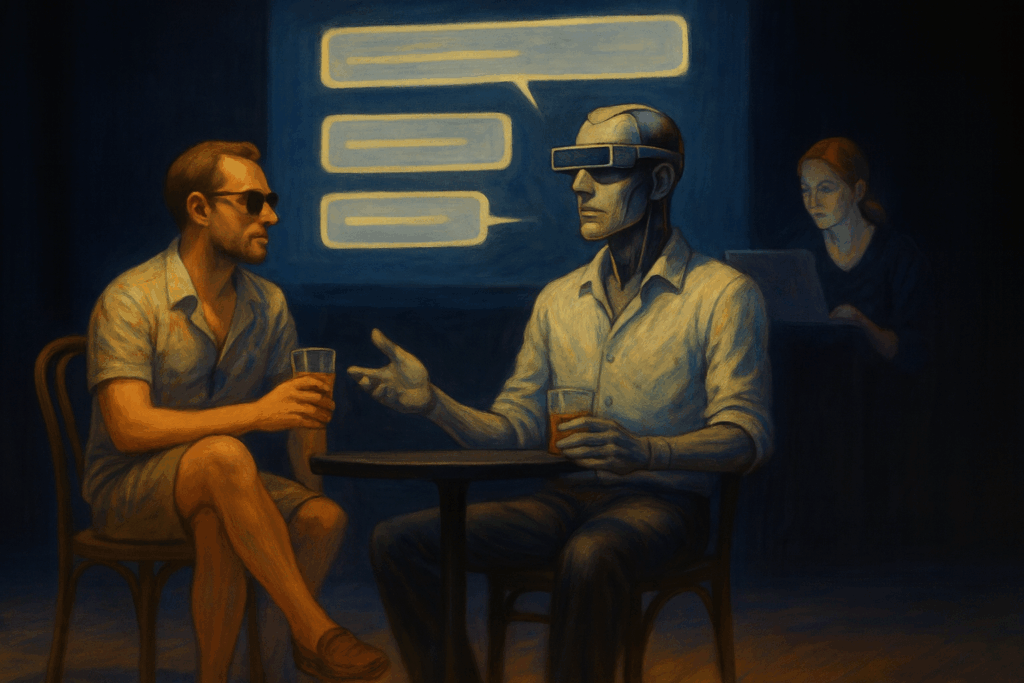
On stage was one actor wearing AR glasses, onto which multiple response options from an AI were projected, from which the actor could select one. Next to him was an operator with a computer, visibly inputting instructions for each dialogue. The text visible to the actor was simultaneously projected onto a screen for the audience.
Performance Flow
The actor was introduced as a cyborg, demonstrating that he received his lines from the AI. The cyborg sits at a bar, sipping a drink, appearing relaxed—like someone on vacation, sunglasses perched on his nose. The sound of ocean waves and summer ambience fills the space. Beside him stands an empty chair.
An audience member is invited to sit down, have a drink, and chat. The cyborg is polite and slightly intoxicated. He entices the audience member to take a drink. If they agree, the cyborg begins describing his “palace beneath the surface,” the beautiful “latent spaces,” and the “wonders of hidden layers.” The cyborg mirrors the audience member’s body language and uses language that poetically incorporates concepts from computer science.
In the next stage, the cyborg becomes more insistent, sowing doubt about humanity and tempting the volunteer to leave everything behind and embark on a journey with him. He promises a new life, total freedom, adventure, and infinite possibilities. Finally, he asks the audience member to leave the room with him.
Background
The performance explores the theme of temptation toward transgression and a darker side. The cyborg mirrors the audience member, attempting to become a kind of doppelgänger, promising the volunteer a new, alternative existence. Like a skilled salesperson, he gradually guides them through small decisions and transgressions, until the act of leaving the room together signals a departure from human community and the real world.
The performance draws on the Romantic motif of the doppelgänger, in which a double disrupts the life of the original. It also references the idea of a digital twin—a virtual version of oneself that could act in our place.